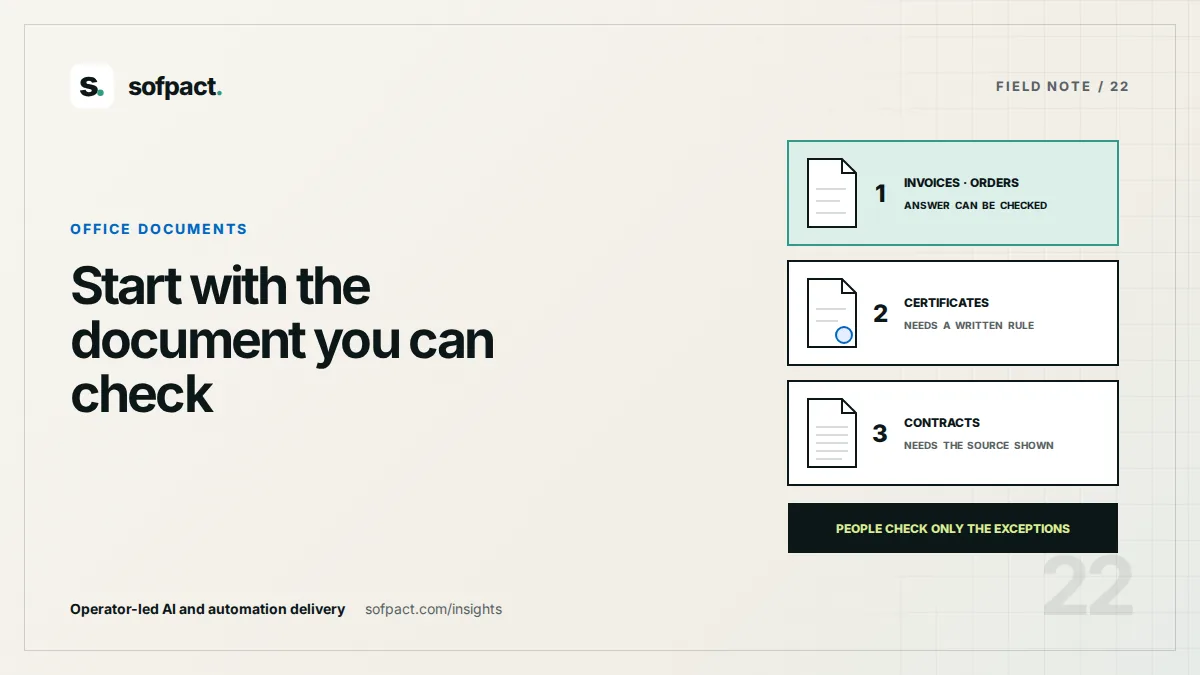
AI takes on office document work best where the document has a known shape, the result goes into a system you already run, and a person checks only the exceptions. For most companies that means supplier invoices or customer orders. Certificates and shipping documents come next, and contracts and internal search come last, because there the right answer is hardest to check. Below are the three families of documents: what changes, the data each needs, what must be true before you start, and what to measure.
Where Bulgarian companies start from
According to Eurostat, in 2023 75.6% of Bulgarian enterprises with ten or more people employed sent paper invoices (EU 70.2%), and 64.5% sent e-invoices not suitable for automated processing, such as PDFs (EU 72.8%). E-invoices in a structured form that a system can read without a person were sent by 15.8% (EU 38.7%). A company often sends invoices in all three forms, so the shares overlap. If incoming invoices look the same, most invoices a Bulgarian company receives probably have to be read by someone before they reach the books.
Also according to Eurostat, 8.6% of Bulgarian enterprises with ten or more people employed used AI in 2025, against 20.0% in the EU. Technologies that analyse written language were used by 5.0% (EU 11.8%), and AI for accounting, controlling or finance management by 2.1% (EU 4.6%). Ready-to-use commercial AI software was used by 5.6% of enterprises. For most companies, the first document application will probably also be their first AI application, and most likely a ready-made product configured to their documents.
Where the document has to land matters as much as reading it. ERP systems are used by 26.6% of Bulgarian enterprises with ten or more people employed (EU 46.5%, Eurostat), and Bulgaria’s National Statistical Institute puts the share at 41.9% of medium-sized and 73.7% of large enterprises. Where there is no ERP, the document ends up in the accounting software and with the accountant, and the application has to fit that path.
1. Documents that become a record
Supplier invoices, customer orders, goods received notes and delivery acceptance records.
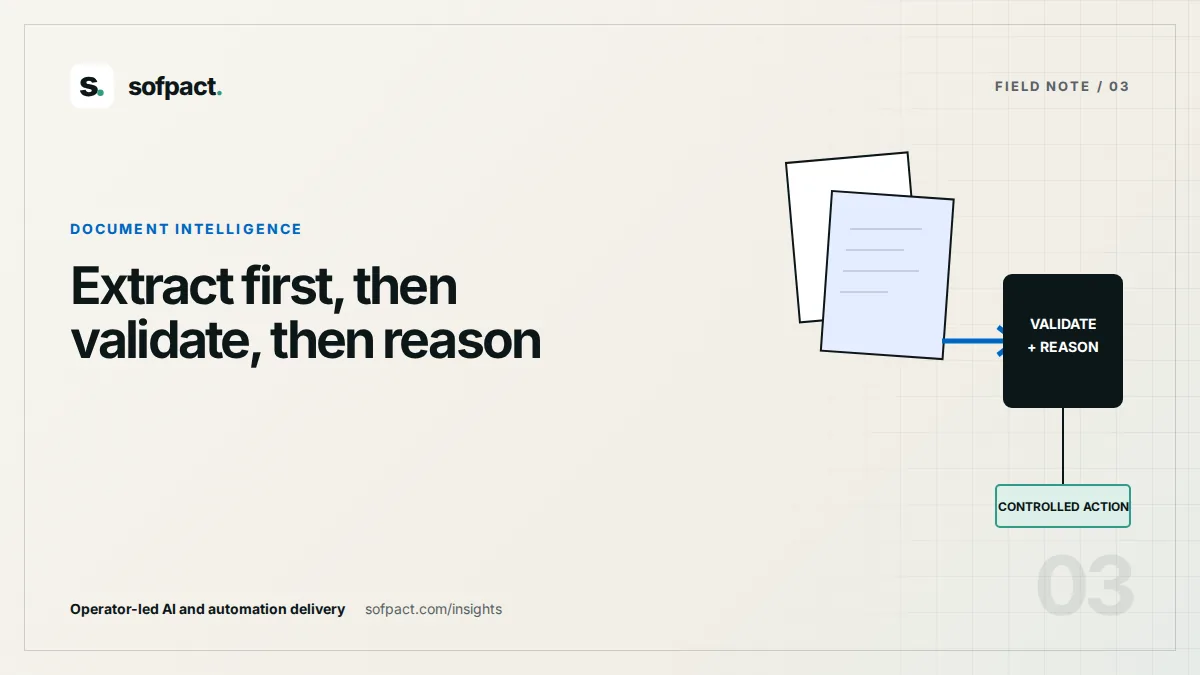
What changes. The model reads the document, fills in the fields (supplier, number, date, lines, amounts, VAT), matches them against the purchase order and the goods received note, and proposes the posting or the order entry. A person sees only the documents where something does not match.
Why now. Bulgaria’s Ministry of Finance put a draft amendment to the VAT Act (in Bulgarian) out for public consultation until 23 October 2026. As drafted, from 1 January 2028 a VAT-registered supplier established in Bulgaria must issue structured e-invoices for domestic supplies when the customer is established in Bulgaria and is a taxable person, a non-taxable legal person or a public body. An invoice counts as issued once the National Revenue Agency’s national system has checked it and assigned a unique compliance code. The technical requirements are to follow in an ordinance of the Minister of Finance, and the draft provides six months for testing the connection to the system. The draft also denies the input VAT deduction where the supplier was obliged to issue a structured e-invoice and did not; what that means for you is for your accountant to say. It is a draft and may change, or may not be adopted. At EU level, the VAT in the Digital Age package (its Directive (EU) 2025/516) has let Member States, under specific conditions, introduce mandatory e-invoicing since 14 April 2025, and from 1 July 2030 cross-border supplies between businesses move to digital reporting based on e-invoices. The common European standard for an e-invoice is EN 16931.
If the draft is adopted as it stands, invoices from VAT-registered suppliers established in Bulgaria, other than those issued at the till as extended fiscal receipts (for fuel, for example), will arrive as structured data that a system reads without a person, and reading them stops being the problem. What remains is the work after the reading: matching against the purchase order and the goods received note, posting, and the exceptions. Invoices from suppliers not registered for VAT and from foreign suppliers (from the EU, at least until 2030), customer orders and certificates will keep arriving as PDFs, on paper or by email. So choose a solution that handles structured invoices as well as PDFs and paper, rather than building something heavy just for reading PDF invoices from Bulgarian suppliers.
Data needed. A sample of the last three months’ documents by type and channel (email, paper, portal, structured e-invoice), the supplier master data, and the purchase orders and goods received notes in the system.
What must be true. One record per supplier, with a correct VAT identification number. A system that accepts an import. A clear rule for who decides when amounts or quantities do not match.
Owner. The chief accountant for supplier invoices; whoever runs order processing for customer orders.
First check: two weeks. How many documents arrive each month by type and channel, and what share of them needs a query today.
What to measure. The share of documents processed without a manual touch; accuracy by field (amount, VAT, supplier); time from receipt to posting; exceptions per 100 documents.
2. Documents checked against a rule
Supplier certificates (of conformity, of analysis, of origin), transport and export documents, warranty cards.
What changes. The model checks each document against a list: is it the right type of document, is it valid on the date, does the batch or shipment match, are all required fields there, is it signed and stamped. Missing and expiring documents come out as a list before a shipment starts waiting.
The difficulty. The right answer depends on a rule, and the rule often lives in one person’s head. So the first job is to write it down: what each market and each large customer requires, for which kind of goods.
Data needed. The list of requirements by market and customer, a sample of documents, and the register of documents received by batch or shipment.
What must be true. Written rules, each with an owner. A register that links each document to its batch or shipment.
Owner. The quality manager for certificates; the head of export or logistics for shipping documents.
First check: two weeks. Write down the rules for the three most frequent document types, and count how many shipments in the last quarter waited for a document.
What to measure. Shipments delayed by a missing or wrong document; expired certificates caught before delivery; time to assemble the documents for one shipment.
3. Documents people search and read
Contracts, internal policies and procedures, correspondence with counterparties.
What changes. Search that answers a question with a quotation from the document and a link to the source. Summaries of the key contract terms (term, renewal, notice, penalties), collected in a register.
The difficulty. Here the right answer is hardest to check: a summary can sound right and be wrong. So every answer shows the text it rests on, and a contract summary enters the register only after a person has checked it.
The legal frame. Contracts and similar documents often contain personal data. If documents pass through an external AI service, check with your lawyers whether its provider processes personal data on your behalf, and what the contract with it must contain under Article 28 of the General Data Protection Regulation. How these rules apply in your case is for your lawyers and data protection officer to decide.
Data needed. The documents in one place, with the current version marked; the access rights.
What must be true. One current version of each document. Access rights that follow today’s rule on who may see what.
Owner. The lawyer or manager responsible for contracts; for procedures, the operations director.
First check: two weeks. How many contracts are active, where they are kept, and whether there is a register of renewal and notice dates.
What to measure. Time to answer a standard question, such as the notice period in the contract with a given supplier; renewal or notice dates missed; the share of answers with the correct source.
Which one first
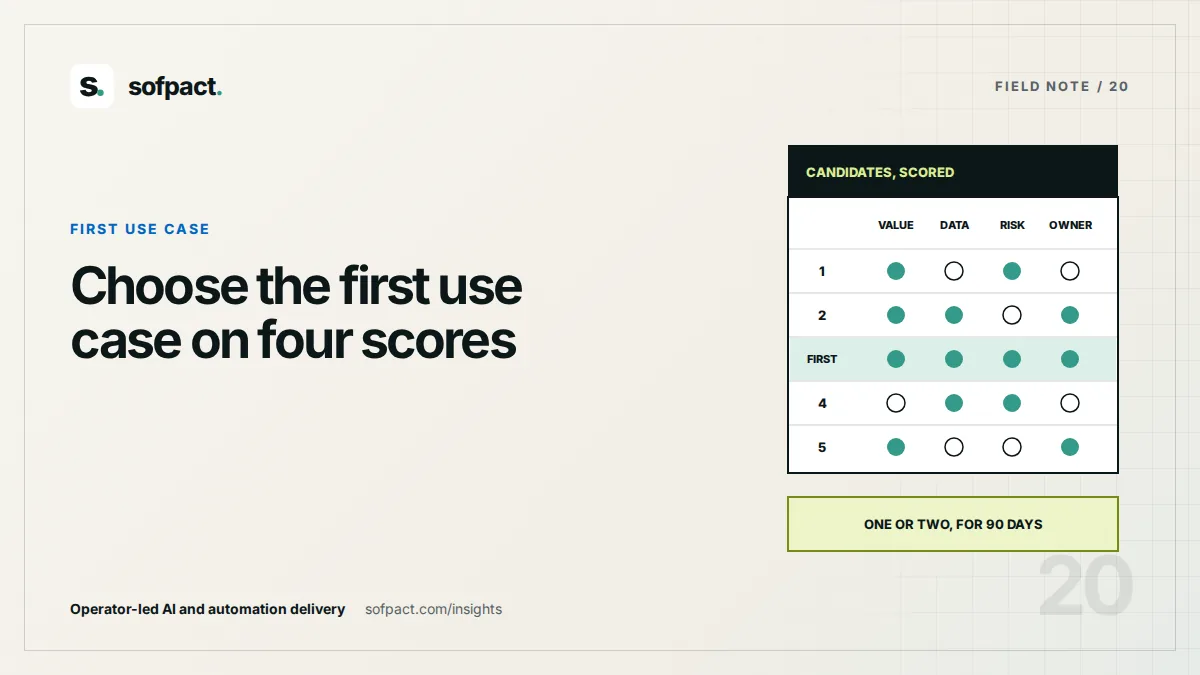
Start with the document that has the largest volume, the clearest right answer and one owner. For most companies that is supplier invoices or customer orders. With supplier invoices, put the effort into matching and exceptions: if the e-invoicing draft is adopted, invoices from VAT-registered suppliers established in Bulgaria, apart from till receipts, will arrive as data. If you export, or sell to chains that require certificates, the second family may save more, because there the cost of an error is a shipment held back. Leave contracts for later, unless a missed date has already cost you money. In all three, record the baseline before the change: without it, the result is an opinion.
How to test it without risking the books
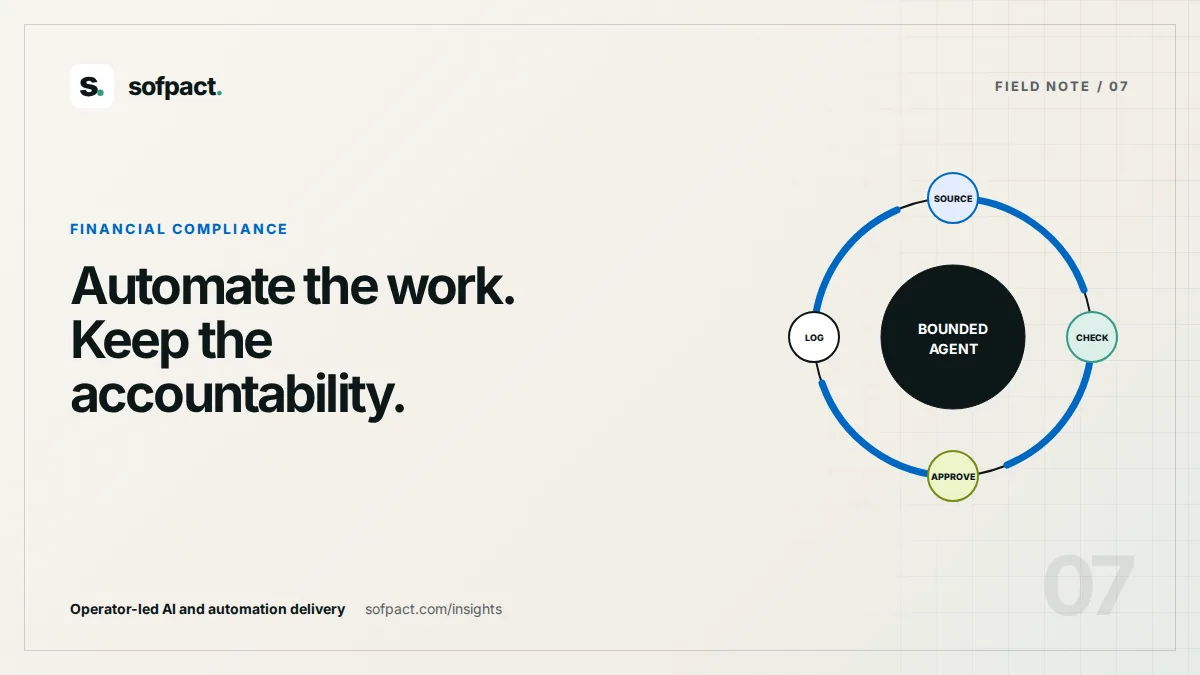
The first 90 days can be arranged so that no document depends on the model before it has proved itself. In the first month the sample is collected and the baseline recorded: time per document, errors, exceptions. In the second the model runs in shadow: it reads the same documents, people work as before, and the difference is logged field by field. In the third month the model takes on one document type from one group of suppliers and posts on its own only when every check passes: the totals add up, the VAT is right, the supplier is in the master data. Everything else goes to a person. At the end there are three possible decisions: scale, fix or stop. If in shadow the model is not more accurate than the current way of working on the fields that matter (amount, VAT, supplier), it does not go live.
What this cannot do
It does not repair poor scans or handwriting. It reads them less reliably, so sometimes the first step is better scanning. It does not repair missing master data: if the supplier is not in the system, its invoice stays an exception. It does not settle a dispute with a supplier. A contract summary is not legal advice. Search is only as good as the version control behind it. And people’s work shifts from typing to checking exceptions, which also has to be planned: who checks, when, and within what time.
If it is not clear which document to start with, that is exactly what the two-week AI strategy discovery decides: interviews, a scored portfolio of applications and a plan for the first 90 days.