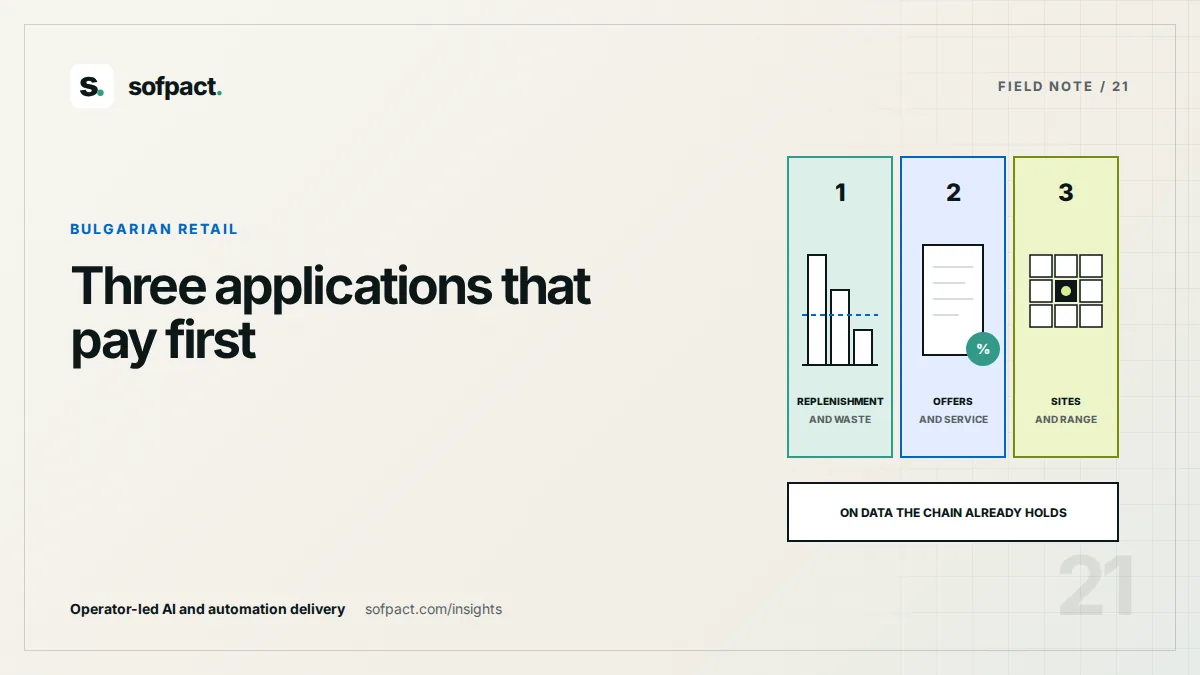
In Bulgarian retail, AI pays first where the chain already holds the data and one person owns the result. That points to three families of applications: replenishment and waste, personalised offers and customer service, and site and range decisions. All three run on data a mid-sized chain already collects: sales by item and store, deliveries, stock, the loyalty programme and store attributes. Below, each in turn: what changes, the data it needs, what must be true before you start, and what to measure.
Where Bulgarian retail starts from
According to Eurostat, 6.0% of Bulgarian retailers with ten or more people employed used AI in 2025, against an EU average of 15.5%. Wholesale is further behind: 8.9% against 23.4%. For marketing or sales, 3.8% of Bulgarian retailers use AI (EU 7.5%); for logistics, 1.2% (EU 2.4%). Among enterprises with 250 or more people employed (excluding the financial sector), 26.2% use AI in Bulgaria against 55.0% in the EU, so for most Bulgarian chains the first application will probably also be their first AI deployment.
The data, however, is already there. Bulgaria’s National Statistical Institute reports ERP systems in 41.9% of medium-sized and 73.7% of large enterprises. Among firms that analyse data with their own staff (22.5% of enterprises), the most common source is transaction records such as sales and payments (76.6%), followed by customer data (57.6%). In a chain, that means receipts, deliveries, stock and the loyalty card. The three families below start there.
1. Replenishment and waste
What changes. A demand forecast by item, store and day that accounts for promotions, holidays and season. The model proposes the order and the markdown before the use-by date; the category manager or store manager decides. In fresh categories an error is paid for twice: a gap loses the sale, and a surplus becomes waste.
Why now. Directive (EU) 2025/1892 sets Member States a target, by 31 December 2030, of cutting food waste per capita by 30%, jointly across retail and other distribution of food, restaurants and food services, and households, compared with the 2021–2023 average. The target is set at national level, for Member States, and retail is part of it. According to Eurostat, retail and other food distribution in Bulgaria reported about 37,000 tonnes of food waste in 2023, or 6 kg per person, against 10 kg for the EU that year. Part of the difference may come from how waste is measured, so your own write-offs are the better baseline.
Data needed. Daily sales by item and store, deliveries and stock, the promotions calendar, write-offs by item and reason.
What must be true. Write-offs are recorded by item and reason, not as one monthly total. System stock is close enough to physical stock to be trusted. Price history from before 1 January 2026 is in leva and is converted to euro at the official rate before the model learns from it. One person owns ordering in the category.
Owner. The fresh-food category manager, with the managers of the pilot stores.
First check: two weeks. How accurate stock is in five stores, and how write-offs are recorded today.
What to measure. Waste as a share of category sales, empty shelf positions and days of stock. Record the baseline before the change.
2. Personalised offers and customer service
What changes. The loyalty card shows what each customer buys. The model proposes which offers suit whom, instead of one leaflet for everyone. In service, AI sorts complaints and enquiries, answers the standard questions and routes the exceptions to a person.
The legal frame. The General Data Protection Regulation gives customers the right to object at any time to processing for direct marketing, including profiling related to it (Article 21). It restricts decisions based solely on automated processing that have legal or similarly significant effects (Article 22), and it requires an impact assessment where processing is likely to result in a high risk to the rights and freedoms of natural persons (Article 35). In Bulgaria the supervisory authority is the Commission for Personal Data Protection. How these rules apply to your programme is for your lawyers and data protection officer to decide, not the model.
Data needed. Loyalty-card transactions, consents and their dates, complaints and enquiries with how each was closed.
What must be true. The legal basis for each use of the data is recorded. The programme links the card to the receipt. Someone owns the offers and sees their effect against a control group.
Owner. The head of the loyalty programme for offers and the head of customer service for enquiries, with the data protection officer alongside.
First check: two weeks. What share of sales runs through the card, and how many enquiries a month are standard.
What to measure. Incremental sales against a control group without the offer, not total sales on the offer; response time; the share of complaints resolved at first contact.
3. Sites and range
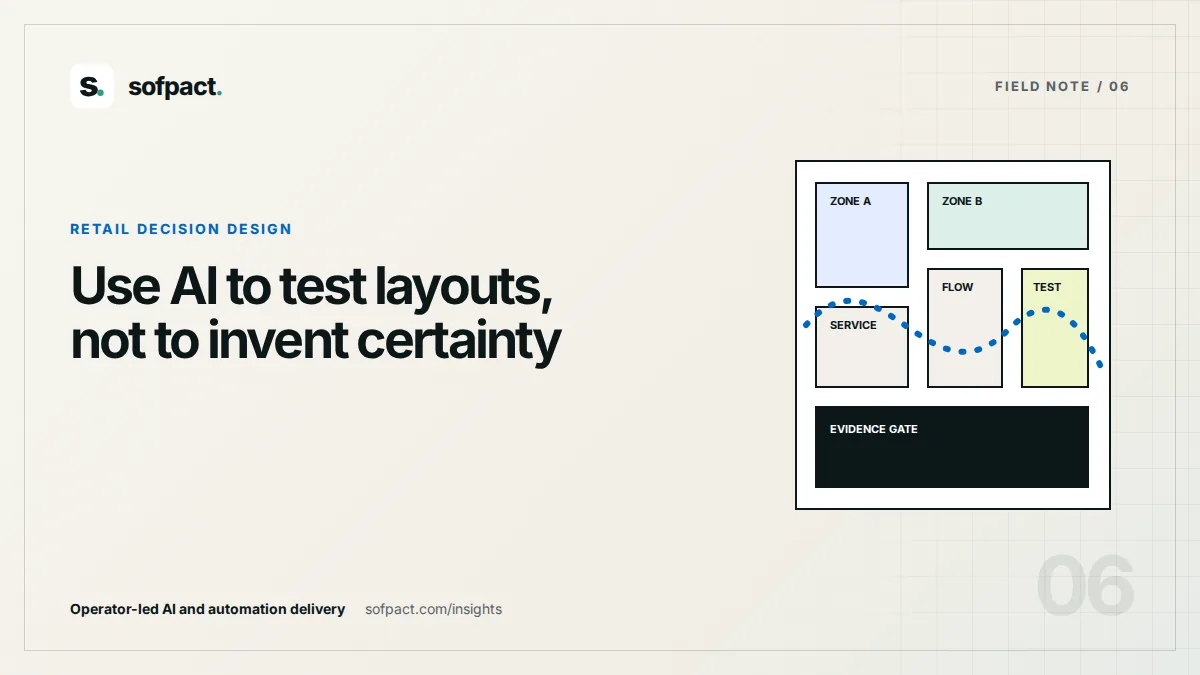
What changes. For a new store, the model compares the site with the most similar existing stores and gives a range of expected sales, not a single number. For range, it groups stores by how they sell rather than by size and proposes what each group should carry. The decision stays with management; the model makes the assumptions visible.
Public data. Eurostat publishes the 2021 census results on an EU-wide grid of 1 km² squares, including population by sex and age and the number of employed residents. Together with your own stores’ sales, that gives a basis for comparing candidate sites without paid data.
Data needed. Sales and results by store and category, store attributes (area, parking, format), opening dates, competitor locations.
What must be true. Enough comparable stores with at least one full year of trading. Attributes described the same way for every store. A review after opening that compares the forecast with the result.
Owner. The expansion director, with the finance director signing off the assumptions.
First check: two weeks. How many recent openings had a forecast the result can be compared with.
What to measure. The forecast’s error against first-year sales, and sales per square metre by store group.
Which one first
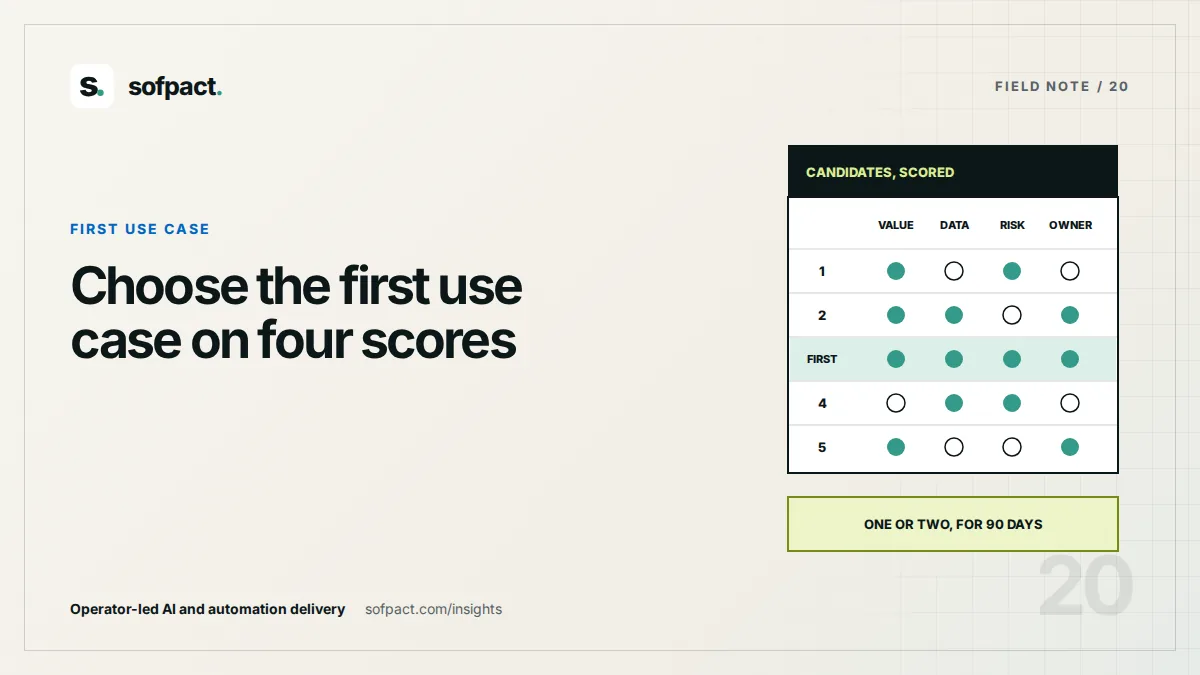
Start where the data is cleanest and an owner exists. For a chain with fresh food, start with replenishment and waste; for a non-food chain with a large loyalty programme, with offers and service. If the board has approved expansion, site appraisal is worth most before the first lease is signed. In all three, record the baseline before the change: without it, the result is an opinion.
How to test it without risking sales
The first 90 days of an application can be arranged so that no store depends on the model before it has proved itself. In the first month the data is checked and the baseline recorded. In the second the model runs in shadow: it forecasts and proposes, but orders and offers are made as before, and the difference is logged. In the third month the proposals are applied in a few stores or for one group of customers, with similar stores or customers left unchanged as the control. At the end there are three possible decisions: scale, fix or stop. If the model does not beat the current way of working in shadow, it does not go into the stores. If it wins in shadow but not in the stores, the cause is usually the process rather than the model: who sees the proposal, when they see it and whether they can change it.
What this cannot do
It cannot repair missing data: if write-offs are not recorded by item, there is no way to show that the forecast reduces them. The model learns from the past and does not see a new competitor or a new format until they appear in the data. It does not replace the category manager’s judgement; it organises it. Customer data is used only within the legal basis on which it was collected. And a site appraisal is a range, not a guarantee: it makes the assumptions visible so that the board can challenge them.
If it is not clear which of the three comes first for your chain, that is exactly what the two-week AI strategy discovery decides: interviews, a scored portfolio of applications and a plan for the first 90 days.